Andrew Abbey
April 13, 2026
7
min. read
and updated on:
May 11, 2026

Agentic coding app development is shrinking timelines in half. Here's what's actually driving it, where the limits are, and what it means for founders hiring a dev shop in 2026.



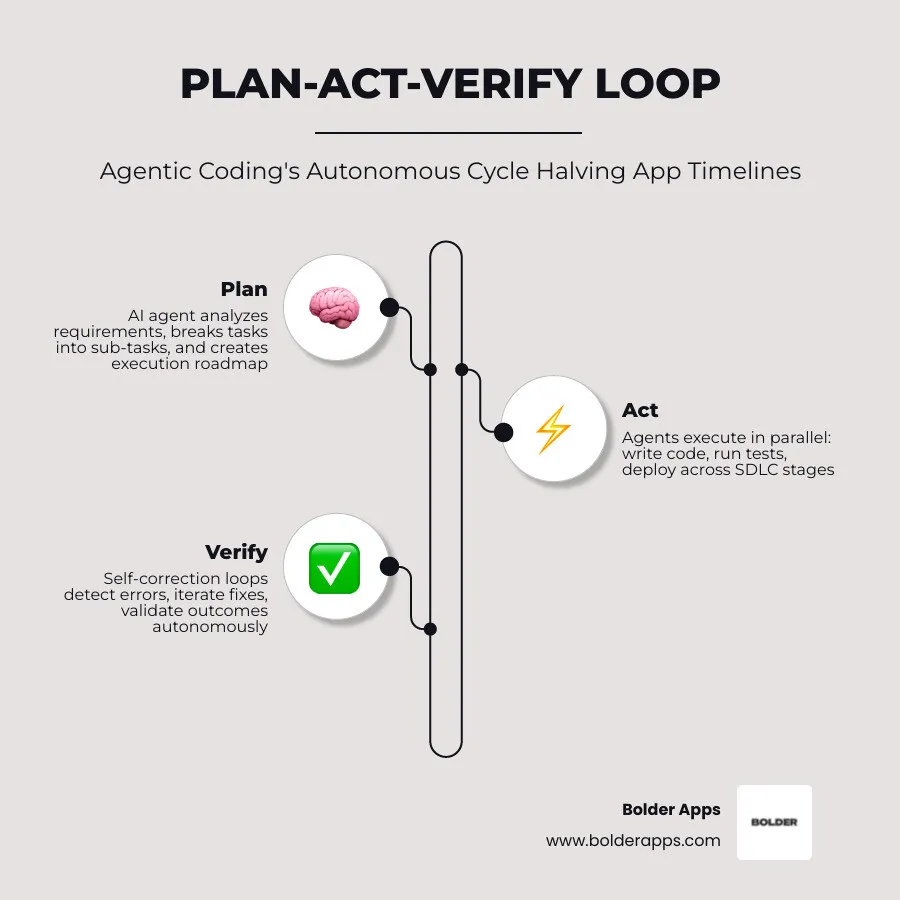
How agentic coding is cutting app development timelines in half in 2026 comes down to one fundamental shift: AI is no longer just suggesting code — it's planning, executing, and verifying it autonomously, in parallel, around the clock.
Here's the quick answer:
Something shifted in late 2025. Developers started waking up to pull-requests that didn't exist when they went to bed. A telecommunications company quietly saved over 500,000 hours. A fintech platform doubled its execution speed. One founder completed a project an agency had quoted at eight months — in two weeks.
This wasn't incremental improvement. It was a category change.
The difference between today's agentic tools and the AI coding assistants of even 18 months ago is the difference between an autocomplete feature and a coordinated engineering team that never sleeps. Where earlier tools reacted to a single prompt, modern coding agents reason over your entire codebase, break work into sub-tasks, assign those tasks to specialized agents running in parallel, and loop back to fix their own mistakes.
As one developer put it after managing four parallel coding agents: he was "wiped out by 11 AM" — not from writing code, but from directing it.
That's the new job. And for founders and product leaders who get it right, the competitive gap opening up right now is enormous.
Glossary for How Agentic Coding Is Cutting App Development Timelines in Half (2026):
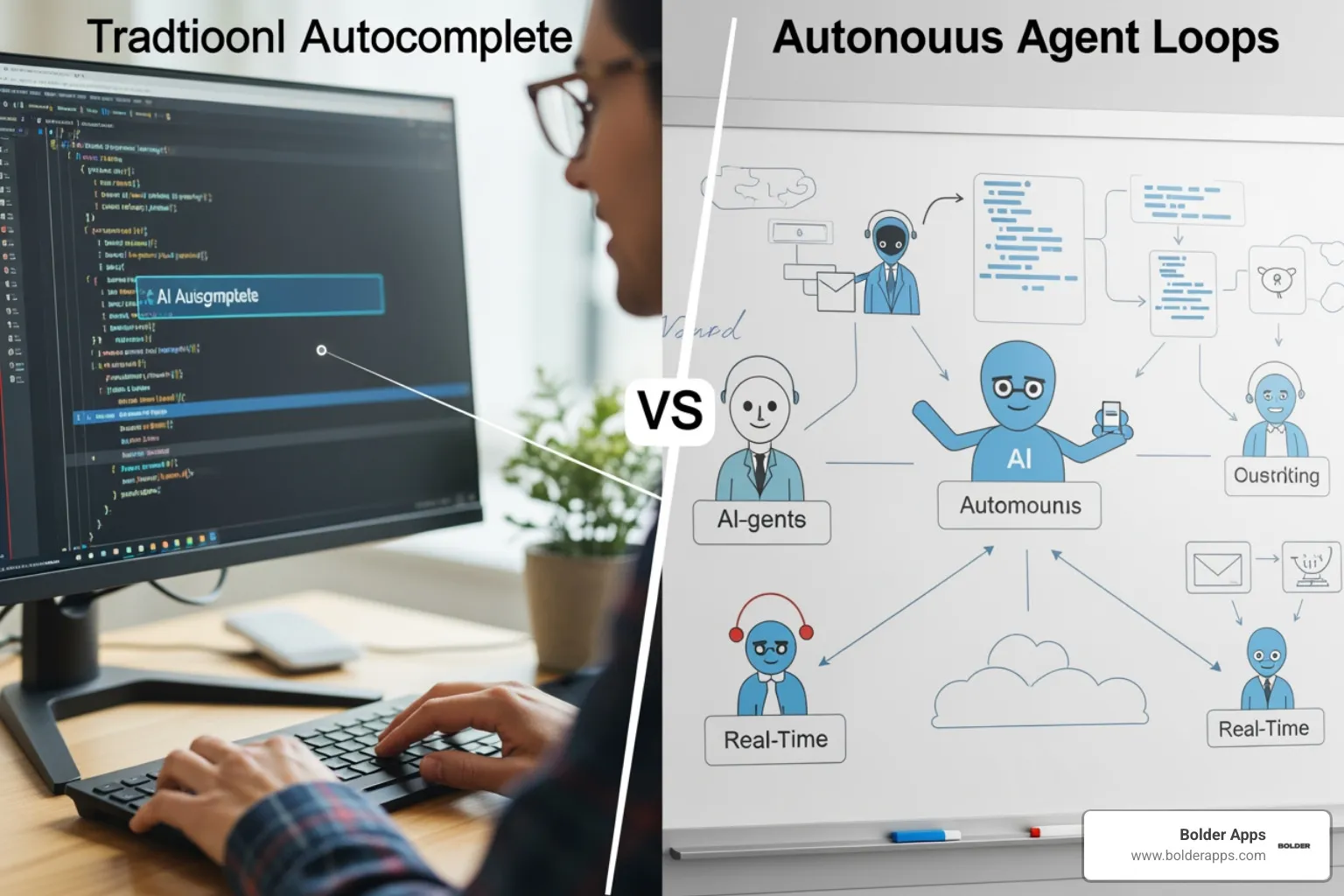
In the early 2020s, we had "Copilots"—glorified autocomplete tools that would finish your sentence if you started typing a function. By 2024, we had chat-based assistants. But in 2026, we have transitioned into the era of Agentic Engineering.
The core difference is "Autonomy Time." While a traditional AI assistant requires a human to prompt, review, and copy-paste every five minutes, an agentic system can run productively for hours or even days. If you give an agent a goal—like "implement a Redis-backed rate limiter across all authenticated routes"—it doesn't just give you a code snippet. It reads your file structure, identifies the relevant routes, writes the implementation, runs the local test suite, and fixes any linting errors it encounters along the way.
Models like Claude 4.6 Sonnet and GPT-5.2 Codex have moved from being reactive (waiting for you) to proactive (doing the work). This is the leap from "assistive" to "agentic." For a deep dive into how to set up these environments, check out our guide on Mastering Claude Code In 2026 9 Ways To Access Anthropics New Agentic Dev Environment.
You might have heard the term "vibe coding" popularized by Andrej Karpathy. In 2026, this has evolved from a hobbyist trend into a professional standard. Vibe coding refers to the intuitive, natural language-driven process of building software. Instead of worrying about syntax or server requests, a founder "describes the vibe" or the high-level intent, and the agentic engine handles the technical heavy lifting.
This shift allows non-technical founders to move at speeds previously reserved for senior engineering teams. We've seen this at Bolder Apps, where we help founders bridge the gap between a "vibe" and a production-ready application. If you're a founder looking to understand this new landscape, our article on Vibe Coding For Founders How Natural Language Programming Is Changing The 2026 Development Lifecycle is a must-read.
What actually happens under the hood of a coding agent? It isn't just one big brain; it's a sophisticated system:
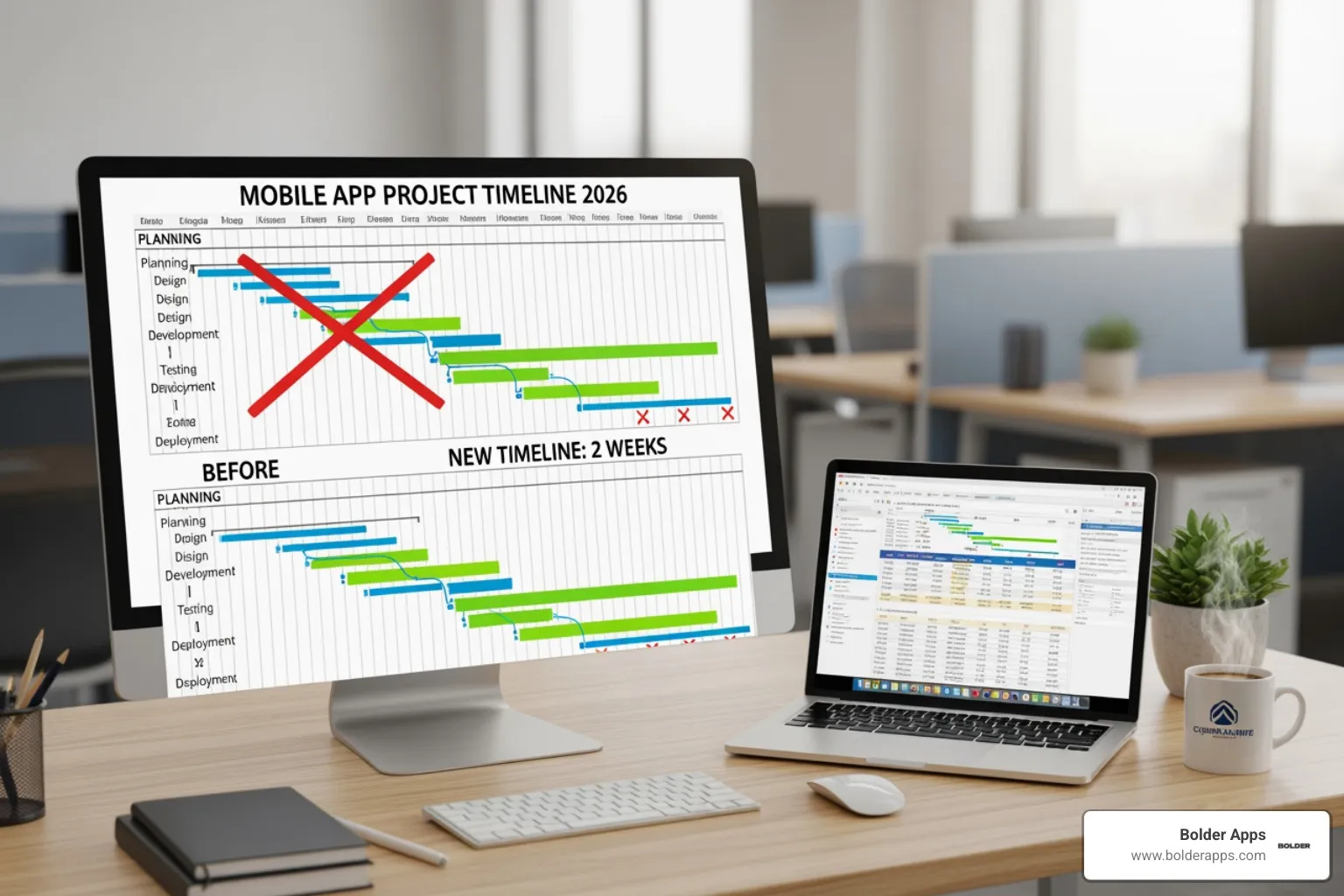
The data is now undeniable: How Agentic Coding Is Cutting App Development Timelines in Half (2026) is no longer a theoretical claim—it’s a measurable reality. According to the [PDF] 2026 Agentic Coding Trends Report - Anthropic, organizations are seeing average timeline reductions of 40% to 50%.
But it’s not just about doing the same things faster. About 27% of the work being done by agents is "new work"—tasks like building internal dashboards, fixing minor "papercut" bugs, or conducting deep security audits that were previously too expensive or time-consuming to address. However, with great speed comes new challenges, which we explore in The Bold Risk Vs Reward Of Using Ai To Build Your Mobile App In 2026.
Traditionally, the Software Development Life Cycle (SDLC) was a linear, often slow process: Requirements -> Design -> Coding -> Testing -> Deployment. In 2026, agentic coding has caused these stages to collapse into one another.
The real "secret sauce" of 2026 is the Multi-Agent System. Instead of one agent trying to do everything, an orchestrator agent coordinates a "swarm" of specialized sub-agents.
Imagine a "Frontend Agent," a "Backend Agent," and a "Security Agent" all working in parallel. Because they have dedicated context windows, they don't get "confused" by the complexity of a large codebase. They communicate via protocols like the Model Context Protocol (MCP), ensuring that the backend changes are immediately reflected in the frontend's understanding. This parallel reasoning is the primary reason we can now build full-stack apps in a fraction of the time.
To understand the scale of this impact, we look at the numbers. At Bolder Apps, we track DORA (DevOps Research and Assessment) metrics to validate how much faster we are shipping. Industry-wide, "Pioneer" teams—those who have integrated agents across at least six stages of the SDLC—report a 2x increase in release cadence.
Significant statistics from 2026 include:
For founders, these aren't just technical wins; they are business wins. As noted in the Gartner 40 Percent Enterprise Ai Agents 2026 Founder Guide, by the end of 2026, 40% of enterprise applications will feature task-specific agents.
One of the most dramatic examples involves a project originally estimated to take 4 to 8 months. Using a Claude-powered agentic workflow, the team finished the core build in just two weeks.
This wasn't a simple "To-Do" app. It involved complex legacy code migration and modernizing a stack that had years of technical debt. Agents were able to "grok" the entire repository instantly, identifying patterns and refactoring modules in parallel while the human lead focused on the high-level architecture. This is the power of the "Dark Factory" pattern—where the implementation happens behind the scenes, leaving humans to focus on the "what" and "why."
We are also seeing the democratization of development. Non-technical domain experts—lawyers, marketers, and operations managers—are now building their own self-service tools. A legal team, for instance, reduced their marketing review turnaround from 3 days to 24 hours by building an agentic triage tool without writing a single line of manual code.
This trend is giving rise to the "One-Person Agency," where a single individual uses a swarm of agents to provide the output of an entire 2023-era dev shop. You can read more about this phenomenon in The Rise Of The One Person Agency How Ai Agents Are Democratizing App Development In 2026.
If agents are so fast, why haven't they replaced developers entirely? The answer lies in the Collaboration Paradox. As AI gets faster at generating code, the human role of oversight becomes more critical, not less.
Agents can still hallucinate or produce "it almost worked" code—functional but vulnerable. Research shows that AI-generated code, without specific security prompting, is only secure about 56% of the time. This is why at Bolder Apps, we use senior engineers to act as "Orchestrators" and "Reviewers." We never ship "vibe code" without a rigorous verification loop.
One of the biggest technical hurdles in 2026 is Context Rot. This happens when an agent's working memory gets filled with noise, old requirements, and irrelevant chat history, causing it to "forget" the original goal.
To combat this, we've moved from "prompt engineering" to "context engineering." This involves structuring the codebase and the agent's instructions so that the most important signals remain clear. Tools like Cursor Composer 2 Ai Coding Model have pioneered new ways to manage this context, allowing developers to maintain high-level control even as the agent dives deep into the implementation.
The Model Context Protocol (MCP) has become the "USB driver" for AI agents. It allows different agents to share tools and data sources seamlessly. For example, in iOS development, an agent can use MCP to interact directly with Xcode, allowing it to build, run, and debug mobile apps with minimal human intervention.
This is a game-changer for mobile development, where environment setup used to be a major bottleneck. To see how this works in practice, check out Ios Agentic Coding Xcode Mcp What It Means.
To actually achieve the "half-time" promise of How Agentic Coding Is Cutting App Development Timelines in Half (2026), you can't just sprinkle AI on top of an old process. You have to rewire your workflow.
We recommend a Spec-Driven Development (SDD) approach. In this model, the human's primary output isn't code—it's a machine-readable specification (like an OpenAPI doc or a Pydantic schema). The agent then uses this spec as its "source of truth" to build the implementation. This ensures that the agent stays within the guardrails of your architecture. Our Mobile App Development Process In 2026 Ultimate Step By Step Guide To Building An App provides a detailed roadmap for this new way of building.
If you’re looking to implement this in your own organization, start with these steps:
Looking ahead, we expect even more acceleration. TurboQuant algorithms are already shrinking the memory footprint of LLMs by 6x, making it cheaper and faster to run complex agent loops. We are also seeing the rise of Self-healing DAGs in data engineering, where pipelines automatically rewrite themselves if they fail.
The "Dark Factory" for software is becoming a reality—a world where the "lights are off" on the code itself, and humans interact only with the high-level intent and the final verified product.
An AI assistant is reactive; it waits for you to ask a question or start a line of code. A coding agent is proactive; it takes a high-level goal, plans the steps, executes the work across multiple files, runs tests, and self-corrects until the goal is met.
Technically, yes, for simpler MVPs and standard web/mobile apps. However, for complex enterprise systems, human oversight is still required for 80% of the work. While agents do the "typing," humans do the "architecting" and "verifying."
It significantly lowers the "cost per feature." While senior engineering talent remains a premium, the total hours required to build an app have dropped by 40-50%. This allows founders to either build for less or build twice as much for the same budget.
At Bolder Apps, we’ve been at the forefront of this revolution since our founding in 2019. In 2026, we were honored to be named the #1 Software and App Development Agency by DesignRush. We didn't get there by just using AI; we got there by mastering the orchestration of it.
Our USP is simple: we combine US leadership (including an in-shore CTO for every project) with senior distributed engineers. We don't believe in "junior learning on your dime." By leveraging agentic coding, we allow our senior architects to do the work of an entire traditional team, ensuring your product is strategic, data-driven, and delivered in record time.
We offer:
Whether you're in Miami or anywhere else in the United States, we’re ready to help you halve your development timeline.
Ready to build the future?Halve your timeline with Bolder Apps mobile developmentVisit our locations page to find a team near you