Abdulla Khaydarov
January 26, 2026
5
min. read
and updated on:
April 24, 2026

"The structured process of turning an idea into a market-ready product through validation, design, development, and launch. Here's what you need to know:"

Startup product development is the structured process of turning an idea into a market-ready product through validation, design, development, and launch. Here's what you need to know:
Core Stages of Startup Product Development:
Key Success Factors:
You have a brilliant idea. A solution that will change how people work, play, or live. But an idea, no matter how great, is just the beginning.
The harsh reality? 90% of startups fail. Nearly 30,000 new products hit the market every year, yet only 5% gain real traction.
Why do so many fail? The research is clear:
42% fail because they're not targeting a market need. They build products nobody wants.
29% run out of money before achieving product-market fit.
19% fail due to not having the right team in place.
The difference between success and failure isn't luck. It's process. High-performing product-led organizations invest in helping teams be productive and deliver value. They follow a disciplined, customer-focused approach from day one.
This isn't about building for the sake of building. It's about solving a problem efficiently, staying on budget, and creating a product that can grow with your vision. The most successful startups understand that the product roadmap is just a guess until customers confirm it.
The good news? A structured product development process can be learned, which means it can be taught. You don't need to make the same mistakes that sink 95% of new products.
In this guide, we'll walk you through the complete startup product development lifecycle—from validating your idea to launching and iterating based on real user feedback. You'll learn the methodologies used by successful startups, how to build the right team, and how to avoid the common pitfalls that drain resources and kill momentum.
Let's turn that bold vision into reality.
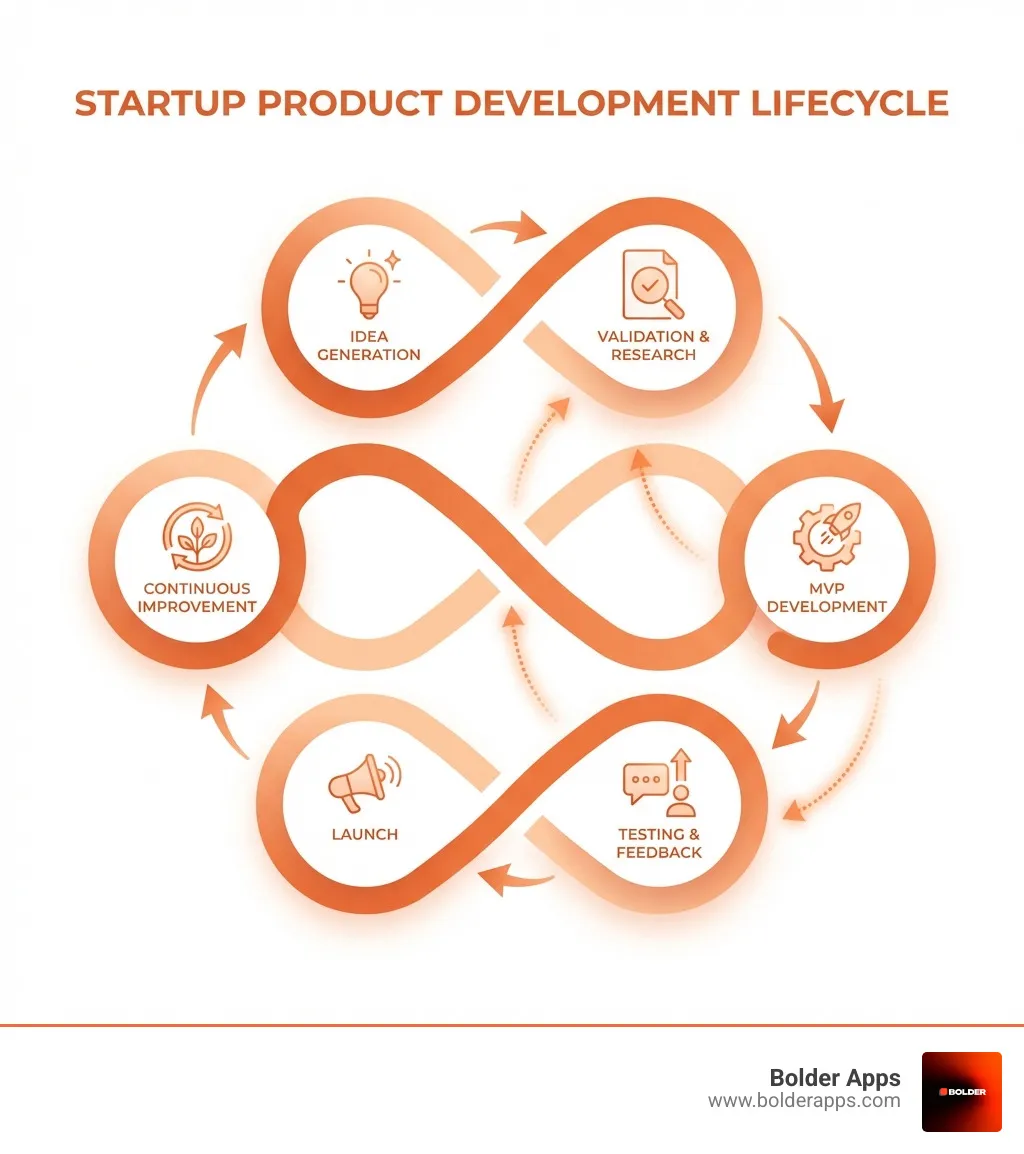
The journey of startup product development is rarely a straight line. It's an iterative, dynamic process that demands flexibility, learning, and adaptation. We accept this reality, understanding that each stage feeds into the next, and constant feedback loops are essential for success. For a deeper dive into the technical aspects of bringing an app to life, you can explore more info about the development process.
Every great product begins with an idea, but not every idea is a great product. This initial stage is all about exploring possibilities and rigorously testing their viability before we commit significant resources.
First, we generate ideas. This often involves brainstorming sessions with our team, researching the market using tools like Google Trends and social media monitoring, and conducting customer interviews and surveys. The goal is to cast a wide net, capturing any and all potential solutions to identified problems.
Next, we dive into market research and competitor analysis. We need to understand industry trends, identify target markets, and pinpoint customer pain points. A thorough analysis of existing solutions helps us identify gaps and differentiate our offering. 42% of startups fail because they're not targeting a market need. We make sure we're not just building a product, but solving a real problem for real people.
The heart of this stage is identifying customer pain points. A pain point is a problem or difficulty a target customer is experiencing, which they would like a solution for. We ask specific questions: "What are you trying to accomplish?", "Why do you think this is so hard?", "What's the main thing getting in your way of being successful?". The most important lesson in product development is that it all comes back to these pain points. We aim to create products that trigger an emotional connection by addressing our users' deepest frustrations.
To screen ideas, we use frameworks like SWOT analysis (Strengths, Weaknesses, Opportunities, Threats) and the RICE method (Reach, Impact, Confidence, Effort). This helps us evaluate ideas based on technical feasibility, market size, and alignment with our capabilities, avoiding the pitfall of building a "Swiss army knife" of features that tries to do too much. With 85% of new products failing, often due to poor research, this validation is non-negotiable.
For inspiration and to kickstart your next big idea, check out our insights on ideas for your next mobile app startup.
Once an idea has passed initial validation, it's time to bring it to life, albeit in a preliminary form. This stage is about defining what we're building and how it will provide value.
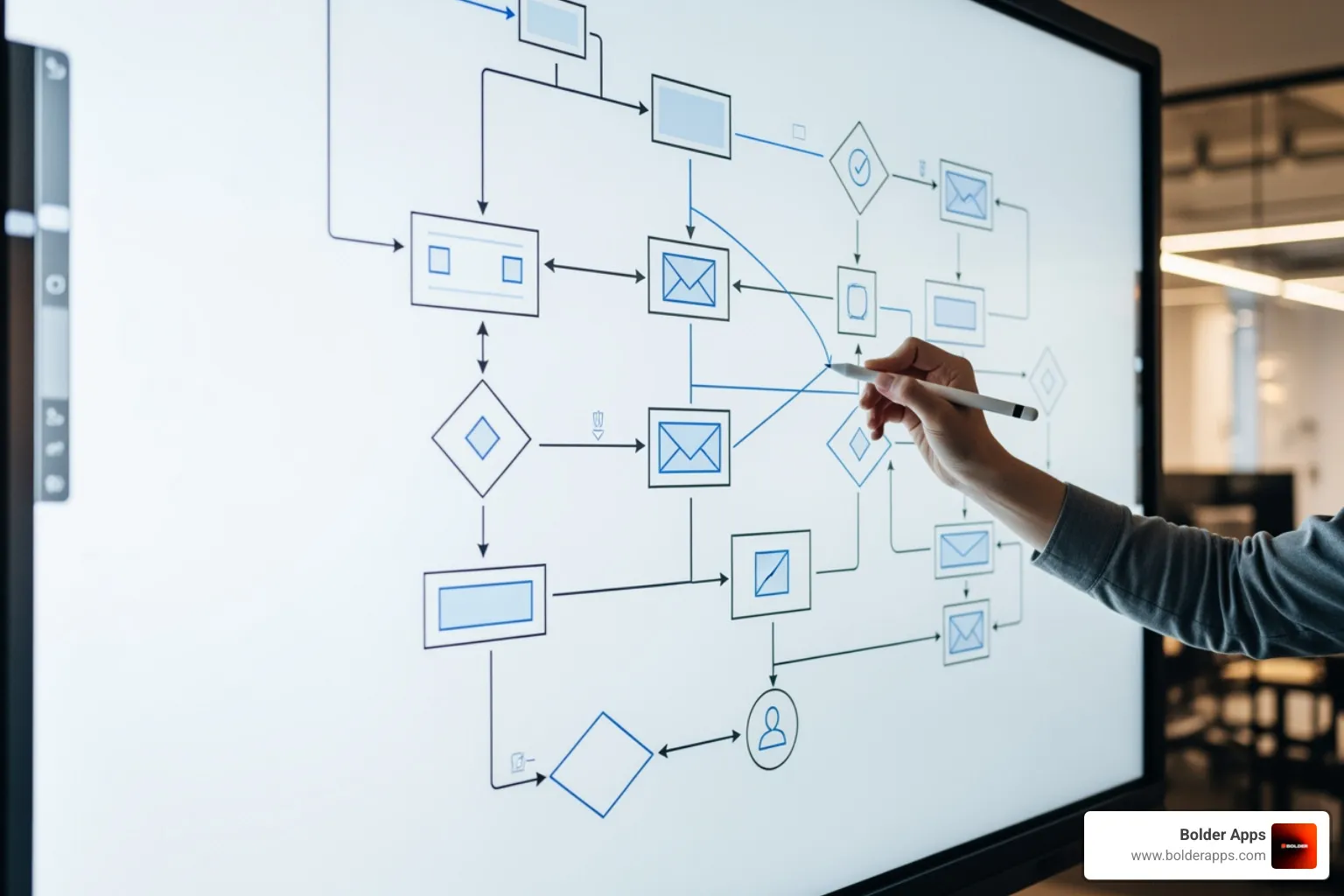
We start by defining the Unique Value Proposition (UVP). What makes our solution stand out? What specific benefit do we offer that competitors don't? We then create user personas to visualize our end consumers and map out their user journeys, ensuring our design choices are truly human-centered.
Wireframes and mockups are our early sketches, representing the product's functionality and user interface. These low-fidelity prototypes allow us to visualize the user experience and gather initial feedback without writing a single line of code.
This leads us to the Minimum Viable Product (MVP). An MVP is the simplest version of a product that can be released to customers to maximize learning. It's about delivering core value with minimal features, allowing us to test core assumptions and gather feedback quickly and efficiently. We don't just aim for a "viable" product; we strive for a Lovable Minimum Product (MLP) – one that people will truly love and want to use. This early validation is crucial, as CB Insights reveals that startups with MVPs have a higher chance of raising capital. For more details on bringing these early concepts to life, explore more info about prototype development.
Crucially, in this stage, we also focus on protecting your intellectual property (IP). Filing copyrights, patents, trademarks, or trade secrets early on is vital. Protecting your IP helps validate your company's assets, which is beneficial when determining your startup valuation.
With a validated concept and a clear MVP in mind, we move into the intensive build phase. This is where the magic happens, turning designs into a functional product.
Choosing the right tech stack is paramount. This decision impacts development speed, scalability, and platform requirements. For mobile apps, we weigh the benefits of native app development (for peak performance and platform-specific features) against cross-platform development (for faster time-to-market and lower costs). For web apps and SaaS platforms, we select robust frameworks, backend services, and databases that ensure a scalable and efficient solution.
Our development process is iterative, focusing on building the core features defined for the MVP. We implement continuous integration/continuous deployment (CI/CD) practices to ensure code is frequently merged and deployed, allowing for rapid feedback and bug detection.
Quality Assurance (QA) is not an afterthought; it's integrated throughout the entire development lifecycle. We conduct rigorous testing, including:
We also leverage AI-powered QA tools to automate repetitive testing tasks, such as regression testing and visual UI comparisons. AI can even predict where bugs are most likely to occur by analyzing code changes and historical data, allowing us to proactively address potential issues. This meticulous approach ensures the product is functional, scalable, and efficient. For a closer look at ensuring your product looks and feels great, dive into more info about UI/UX design.
The launch isn't the finish line; it's the starting gun for continuous improvement. This stage focuses on bringing the product to market and learning from its real-world performance.
Developing a robust go-to-market strategy is crucial. This involves lining up manufacturing and supply chains (if applicable), setting up quality control checks, preparing marketing materials and a compelling website, and training the sales team for launch. We also align marketing and sales efforts to ensure a unified message and smooth customer acquisition.
When it's time to launch, we consider platforms relevant to your audience to gain initial traction. For many digital products, this might include targeted campaigns and even launching on platforms like Product Hunt.
Crucially, the post-launch phase is all about gathering user feedback, analytics, and KPIs. We actively monitor customer reviews, social media mentions, and direct feedback. 83% of customers feel more loyal to companies that address their complaints. Listening to our users isn't just good customer service; it's a direct pathway to product improvement.
This entire cycle embodies the "Build-Measure-Learn" loop. We turn ideas into products, measure how customers respond, and then learn whether to pivot (make a significant change) or persevere (continue on the current path). We track key metrics like user engagement, adoption rates, conversion rates, and customer satisfaction to assess realized value and inform future iterations. For a deeper understanding of shaping your product's direction, explore more info about product strategy.
Different startups and projects require different approaches. While the core stages of startup product development remain, the methodologies we employ can significantly impact speed, flexibility, and outcomes. We compare the most effective modern methodologies to help you choose the right playbook for your venture.
The Lean Startup methodology, popularized by entrepreneur Eric Ries, is a game-changer for startups operating under conditions of extreme uncertainty. It prioritizes speed and learning over extensive planning.
At its core is the "Build-Measure-Learn" feedback loop. Instead of spending months on heavy planning, we create a Minimum Viable Product (MVP) (Build), release it to gather data on customer responses (Measure), and then analyze that data to learn whether our initial hypotheses were correct (Learn). This continuous cycle helps us quickly validate ideas and decide whether to pivot our strategy or persevere with our current direction. The fundamental activity of a startup, according to Ries, is to turn ideas into products, measure how customers respond, and then learn whether to pivot or persevere. All successful startup product development processes should be geared to accelerate that feedback loop.
Agile is a flexible, iterative approach to product development that is exceptionally well-suited for the dynamic and uncertain environment of a startup. Instead of a rigid, linear process (like the traditional "waterfall" method), Agile breaks down development work into small, manageable chunks called "sprints" or "iterations."
Frameworks like Scrum and Kanban are popular within Agile. Scrum uses short, time-boxed iterations (sprints, typically 1-4 weeks) with daily stand-ups, sprint reviews, and retrospectives. Kanban focuses on visualizing workflow, limiting work in progress, and maximizing efficiency. Agile projects are completed 24% faster than traditional approaches, making it ideal for startups needing to move quickly. The Agile Manifesto states, "Responding to change over following a plan." This mindset allows us to quickly incorporate new information, market shifts, and user feedback into our product roadmap without derailing the entire project.
Design Thinking is a human-centered problem-solving framework that puts the end-user at the heart of the product development process. It's less about a rigid process and more about a mindset that encourages creative and innovative solutions. The IDEO Process, made popular by the design firm IDEO, is a prime example of this approach, focusing on the human experience above all else.
The process typically involves five stages:
Design Thinking fosters innovation by ensuring that solutions are not only feasible and viable but also desirable and truly resonate with the people who will use them.
Even with the best ideas and methodologies, successful startup product development hinges on having the right people and the right tools.
Deciding how to build your product development team is a critical choice for any startup.
An in-house team offers full control, direct communication, and a deep understanding of your company culture. However, it comes with significant challenges: exorbitant initial costs (salaries, benefits, office space), and a time-intensive recruitment process to find specialized talent. For many startups with limited funding, building a complete in-house team from scratch can be a major hurdle, with 19% of startups failing due to not having the right team in place.
Outsourcing can be a strategic advantage. It provides cost efficiency, access to a global pool of specialized skills (without the long-term commitment of hiring), and scalability to ramp up or down as needed. It significantly reduces recruitment time and overhead.
At Bolder Apps, we offer a hybrid model designed to give you the best of both worlds. We combine US-based leadership, ensuring clear communication and strategic oversight, with senior distributed engineers. This approach means you benefit from top-tier talent and expertise, without the high costs and lengthy recruitment processes of building a full in-house team. Crucially, we ensure no junior learning on your dime – you work with experienced professionals from day one. For a comprehensive look at structuring your team, read more about building a development team.
The right tools can streamline your startup product development process, improve collaboration, and provide crucial insights. Here's a selection of essential technologies we recommend:
Navigating startup product development can raise many questions. Here, we address some of the most common ones.
We've seen many startups stumble, and the patterns are often surprisingly consistent:
This is the million-dollar question, and frankly, it varies widely! The cost of startup product development depends heavily on:
On average, the new product development costs can range from $30,000 to $300,000 or more, entirely depending on the complexities of the application. For a detailed breakdown of costs, including factors like app type and features, check out our comprehensive guide: How Much Does It Cost to Make an App in 2026?.
Just like cost, the timeline for startup product development is highly variable.
Methodologies like Agile and Lean Startup are specifically designed to shorten these cycles. By breaking work into sprints and constantly iterating based on feedback, we aim to get a viable product into users' hands faster, allowing us to learn and adapt quickly. Agile projects, for instance, are completed 24% faster than traditional approaches, highlighting the efficiency gains of these modern methodologies.
The journey of startup product development is undeniably challenging, but it is also immensely rewarding. Turning a nascent idea into a thriving product requires more than just innovation; it demands a structured process, deep user empathy, continuous validation, and the right team by your side. By embracing methodologies like Lean Startup, Agile, and Design Thinking, and by diligently avoiding common pitfalls, you significantly increase your chances of building something truly impactful.
At Bolder Apps, we understand the unique pressures and aspirations of startups. Our unique approach is designed to empower your vision: we combine US-based leadership with senior distributed engineers, ensuring strategic oversight and high-quality execution without the typical overheads. We operate on a fixed-budget and milestone-based payment model, providing financial predictability and ensuring projects are completed efficiently and to your satisfaction. And critically, we guarantee that you'll never have junior developers learning on your dime—only experienced professionals contributing to your success.
Ready to turn your bold vision into reality? Partner with us for your custom software development needs and build something bolder!