
Madina M
January 29, 2026
5
min. read
and updated on:
February 25, 2026

Master Swift Programming For iOS App Development: Build powerful, native apps. Learn tools, SwiftUI, and jumpstart your career.
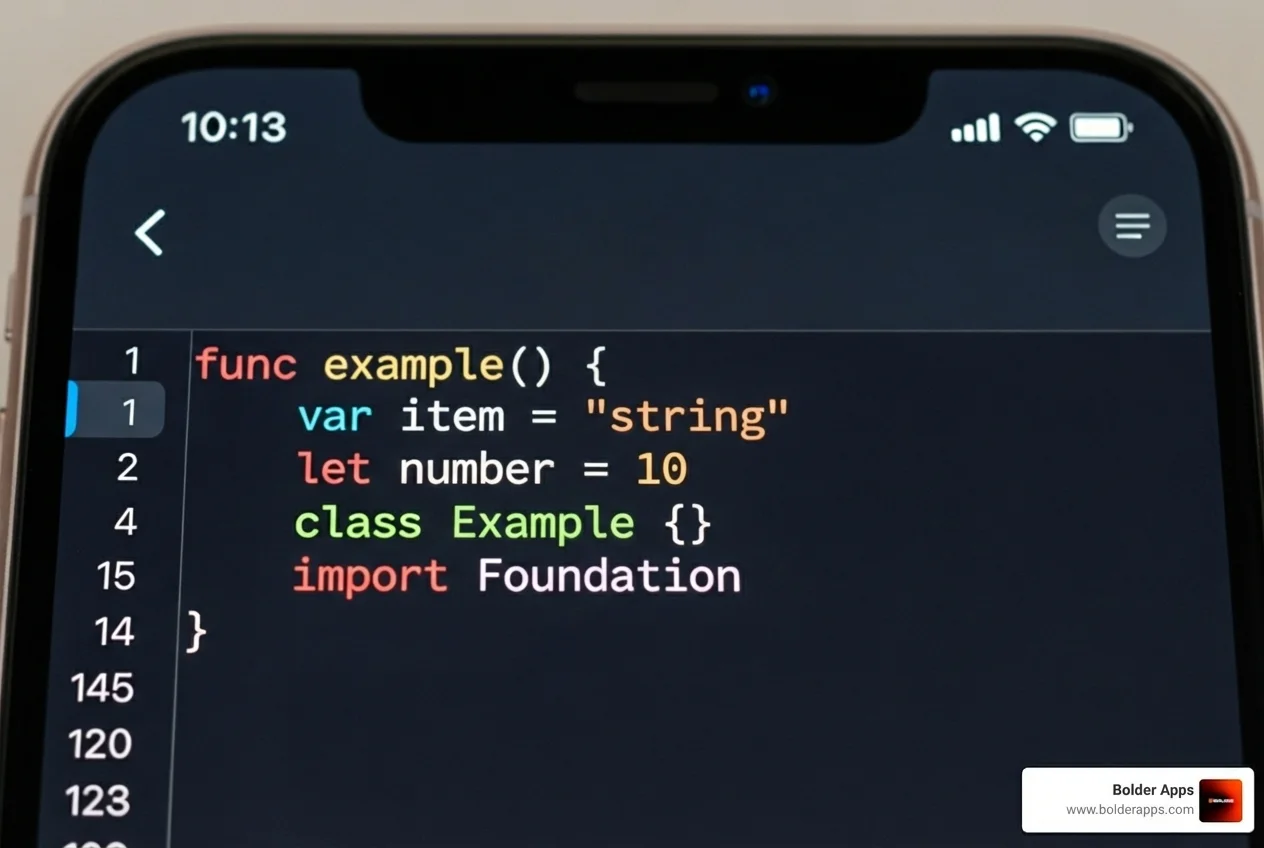
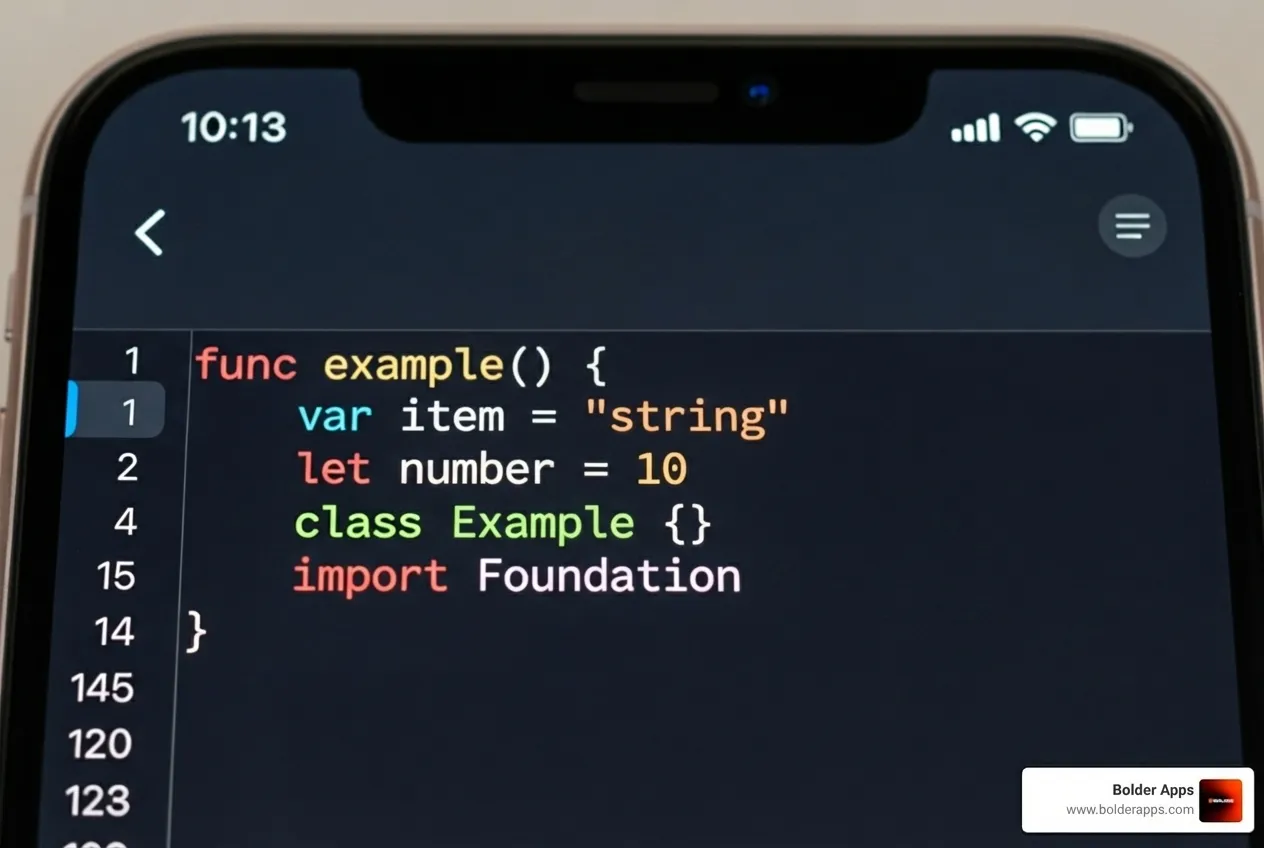
Swift Programming For iOS App Development is the foundation for creating world-class applications in Apple's ecosystem. If you're building an iOS app today, here's what you need to know:
What is Swift?
Why Choose Swift for iOS Development?
Every successful business today has mastered the art of meeting customers where they spend their time. And increasingly, that place is iOS devices. The App Store ecosystem facilitated $1.3 trillion in total billings and sales in 2024, with over 1 billion users globally actively using iOS apps.
Swift isn't just a programming language—it's your gateway to this massive, affluent user base. Unlike its predecessor Objective-C, which dated back to the 1980s, Swift was designed from the ground up to be approachable for newcomers while remaining powerful enough for the most demanding applications. Whether you're building a simple utility app or a complex game with cutting-edge AR features, Swift provides the tools you need.
The language's safety features mean fewer crashes and security vulnerabilities. Its speed means your app performs flawlessly. And its expressive syntax means your development team can build faster and maintain code more easily. For business leaders looking to build market-leading digital products, understanding Swift is no longer optional—it's essential.
Important Swift Programming For iOS App Development terms:
When it comes to building applications for Apple's diverse ecosystem—be it an iPhone, iPad, Apple Watch, Apple TV, or Mac—Swift stands out as the primary and most powerful programming language. Its design principles prioritize modern development needs, making it a compelling choice for any serious iOS project.
The decision to choose Swift for Swift Programming For iOS App Development is backed by a suite of compelling advantages that directly translate into better, more reliable, and more maintainable applications.
First and foremost is safety by design. Swift was engineered to eliminate entire classes of bugs common in older languages. Features like strong typing, optionals that prevent nil pointer errors, and robust error handling mean developers spend less time chasing bugs. This focus on safety makes your app more stable and secure from the ground up.
Next is speed and performance. Swift compiles directly to native code, with execution speeds comparable to C-based languages. This performance is critical for demanding applications like games or complex animations, ensuring a smooth user experience.
Then there's expressive syntax and readability. Swift uses a concise, readable syntax that's easy for beginners to understand. This clarity reduces the learning curve and improves team collaboration, as the code reads almost like plain English.
Interoperability with C/C++ and Objective-C is another massive win. Swift interoperates seamlessly with C-based languages, allowing for incremental adoption into existing Objective-C codebases. This protects past investments while paving the way for modernization.
Swift features Automatic Reference Counting (ARC) to automate memory management. This frees developers from manual memory tasks, reducing bugs and speeding up development while ensuring efficient resource use.
Finally, Swift's status as an open-source language has fostered a vibrant community. This leads to continuous improvement, shared resources, and adoption beyond Apple's platforms for server-side and embedded systems development. You can Join the Swift forums to engage with this community.
For decades, Objective-C was the workhorse of Apple's platforms. However, its origins in the 1980s meant it carried a lot of baggage. Swift was explicitly developed as a replacement, offering a fresh, modern approach to Swift Programming For iOS App Development.
The contrast is stark when comparing legacy vs. modern. Objective-C's verbose syntax made it less approachable and harder to read. Swift boasts a clean, intuitive syntax that is much simpler to read and write, often requiring significantly fewer lines of code to achieve the same functionality. This directly impacts readability and code length.
This improved readability and conciseness contribute to easier maintenance. Older Objective-C codebases can be notoriously difficult to maintain. Swift's clarity saves time in the long run, reducing the chances of introducing new bugs during modifications.
Crucially, Swift's built-in safety features are a game-changer. Objective-C lacked many of these modern safeguards, so developers had to be extra vigilant about issues like nil pointers. Swift's type safety and optionals proactively prevent many common programming errors, leading to more robust applications.
While both languages offer comparable performance, Swift's modern compiler optimizations and predictable memory management often give it an edge.
However, interoperability allows coexistence. You don't have to rewrite your entire Objective-C app in Swift overnight. Swift can seamlessly call Objective-C code and vice versa, allowing teams to gradually migrate to Swift. It's a testament to Apple's forward-thinking design, allowing for a smooth transition. For a deeper dive, check out our guide on the Mobile App Development Process in 2026: Ultimate Step-by-Step Guide to Building an App.
When starting an app development journey, a key strategic decision is the development approach: native, cross-platform, or hybrid. While cross-platform frameworks like React Native or Flutter offer a single codebase for multiple platforms, native development with Swift for iOS provides unparalleled advantages.
Native development benefits are clear:
Cross-platform and hybrid solutions can offer faster time-to-market for simpler apps, but they often come with cross-platform limitations. These can include compromised performance, limited access to native features, and a generic UI that doesn't accept the nuances of iOS. Hybrid apps, which wrap web views in a native container, often suffer from performance issues and a non-native feel.
So, when to choose native? If your goal is a high-performance, feature-rich application that offers a best-in-class user experience, then native Swift Programming For iOS App Development is the clear winner. For businesses targeting the premium iOS user base, a native Swift app provides a significant competitive edge and higher potential for ROI.
Diving into Swift Programming For iOS App Development requires a specific set of tools. Thankfully, Apple provides everything you need, mostly for free, to get started.
A Mac computer is the cornerstone of your iOS development journey. While virtual machine workarounds on Windows exist, they are unstable, slow, and not recommended. For the best experience, a native Mac environment is non-negotiable. An iPhone or iPad is also recommended for testing, but Xcode's simulators can fill the gap.
The heart of your software environment is Xcode, Apple's Integrated Development Environment (IDE). Xcode is a powerful, all-in-one suite that includes everything you need:
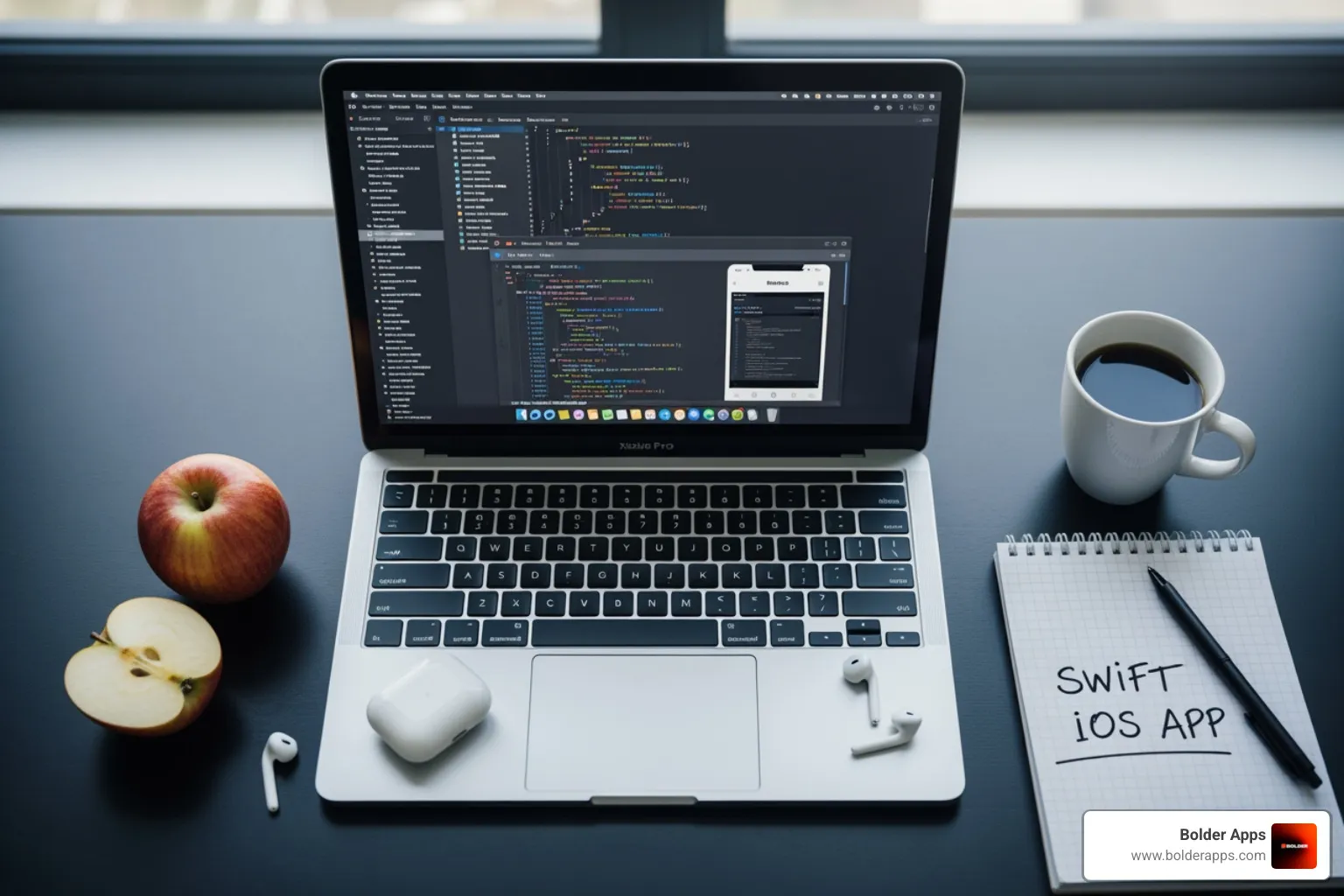
Xcode is free, but distributing your app on the App Store requires enrolling in the Apple Developer Program. This annual subscription provides access to beta software, advanced app capabilities, and submission for App Store review.
Mastering Swift Programming For iOS App Development is achievable with numerous high-quality resources. A combination of the following approaches usually yields the best results.
Here are some of the most effective ways to learn Swift:
LIST of top learning paths:
The best way to learn is by doing. Write code, experiment, and don't be afraid of errors—they are your best teachers!
Swift's design philosophy emphasizes clarity, safety, and modern programming practices, making it a joy to work with. Its power for Swift Programming For iOS App Development comes from understanding its fundamental building blocks.
var (changeable values) and let (constants set only once). This promotes safer code by preventing accidental modifications.Int, Double, Float, Bool, and String. This helps catch type-mismatch errors early.Arrays: Ordered collections of values.Dictionaries: Unordered collections of key-value pairs.Sets: Unordered collections of unique values.if/else and switch statements for conditional logic.for-in, while, and repeat-while loops for iteration.Functions: Reusable blocks of code for organizing logic.Closures: Self-contained blocks of functionality that can be passed around, powerful for tasks like sorting and asynchronous operations.Beyond the basics, Swift provides robust tools for code organization, essential for building scalable and maintainable applications.
Swift accepts multiple programming paradigms, including Object-Oriented (OOP), functional concepts, and Protocol-Oriented Programming, which is heavily favored in the Apple ecosystem.
A key decision in Swift is choosing between Classes vs. Structures, which hinges on value vs. reference types:
Structures are value types (a copy is independent), ideal for modeling data.Classes are reference types (a copy refers to the same instance), suitable for entities with shared state.Enumerations (Enums) are powerful for defining a type for a group of related values, preventing invalid states. They can even have associated values and methods.
Protocols and Extensions are central to Protocol-Oriented Programming.
Protocols define a blueprint of methods and properties that a type must conform to, promoting modular design.Extensions add new functionality to existing types, even without access to the original source code.Generics enable you to write flexible, reusable functions and types that work with any type, reducing code duplication.
Leveraging these features ensures high code quality and maintainability. For complex projects, a professional Code Audit can pinpoint areas for improvement and ensure your codebase is robust and future-proof.
Swift is deeply integrated into Apple's development ecosystem, which provides powerful frameworks that simplify creating sophisticated iOS applications.
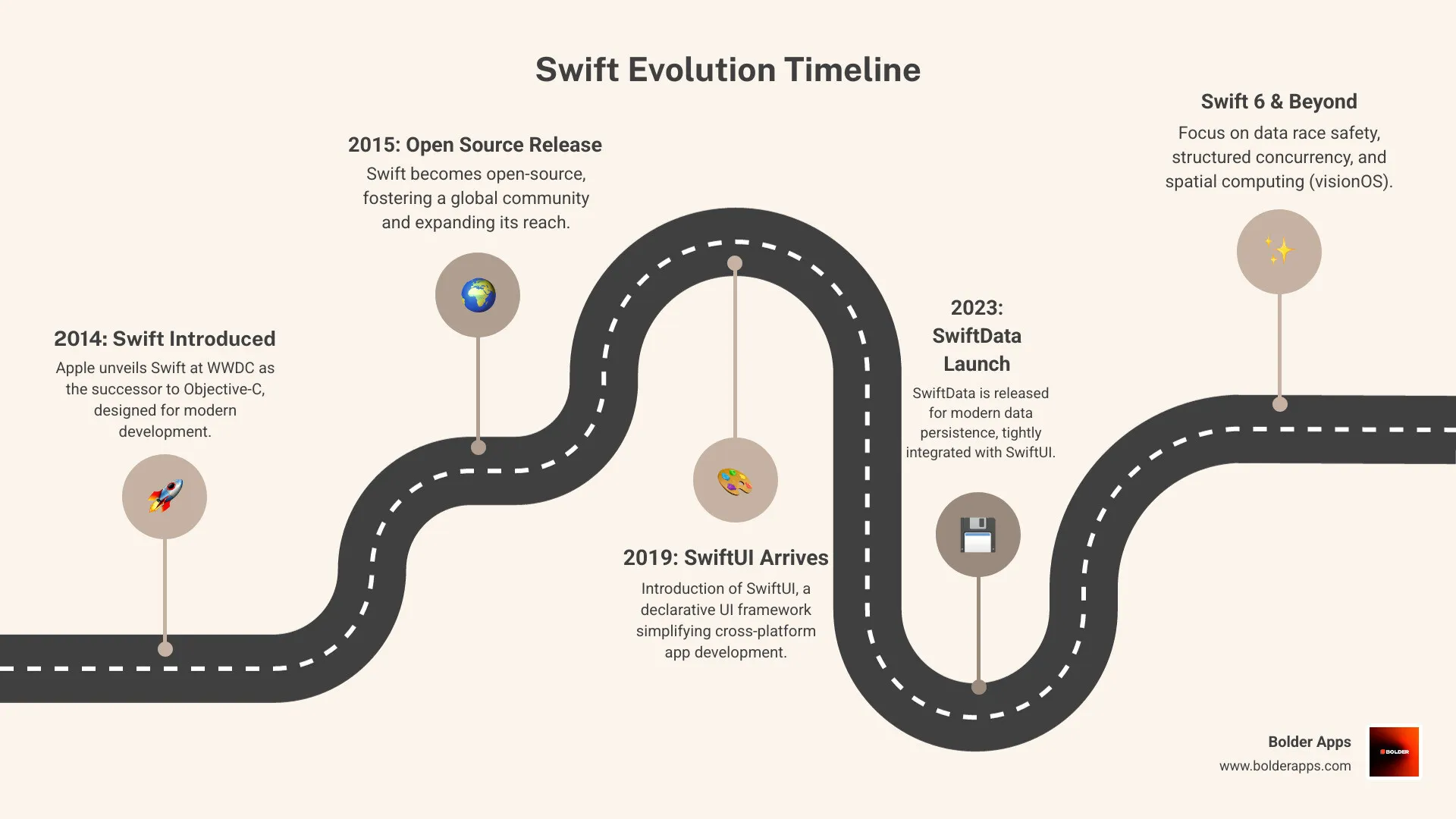
One of the most exciting advancements in Swift Programming For iOS App Development is SwiftUI. Introduced in 2019, it represents a paradigm shift in UI development.
While UIKit remains important for legacy projects, SwiftUI is the future of UI development in the Apple ecosystem. It's ideal for quickly bringing designs to life, which is why our Prototype Development services often leverage its speed and flexibility.
For modern data persistence in Swift Programming For iOS App Development, SwiftData is Apple's powerful and intuitive answer. Introduced in 2023, it simplifies data modeling and management.
Modern apps must perform background tasks without freezing the UI. Swift simplifies concurrency and asynchronous programming with its async/await syntax.
The demand for skilled Swift developers remains robust, leading to exciting career opportunities and competitive salaries. The future of Swift Programming For iOS App Development is also constantly evolving, driven by Apple and the open-source community.
The iOS market is a behemoth, with a 56.63% market share in the US and over 1 billion active users globally. This creates constant, high demand in the job market for talented Swift developers.
The high demand for Swift developers translates to competitive salaries, making it an excellent strategic career move. For businesses looking to scale their teams, our Staff Augmentation services can bridge skill gaps with seasoned Swift experts.
Exciting future trends are constantly emerging in the landscape of Swift Programming For iOS App Development.
These advancements underscore Swift's role as a robust, future-proof choice for development on Apple's platforms and beyond.
We've journeyed through the intricacies of Swift Programming For iOS App Development, from its foundational principles and compelling advantages over Objective-C, to the essential tools and modern frameworks that define the Apple ecosystem. We've seen how Swift's commitment to safety, speed, and expressiveness translates directly into high-quality, reliable, and engaging applications. The language's intuitive syntax and powerful features, combined with frameworks like SwiftUI and SwiftData, empower developers to create cutting-edge experiences, including those for the exciting new world of spatial computing.
However, navigating this complex and rapidly evolving landscape requires more than just technical knowledge; it demands expertise, strategic vision, and a flawless execution. Building a high-impact iOS app isn't just about writing code; it's about crafting a digital product that stands out, performs flawlessly, and delivers tangible value to your users and business.
This is where Bolder Apps steps in. We are a digital product development company dedicated to creating high-impact mobile and web apps. Our unique value proposition combines US leadership with senior distributed engineers, ensuring that your project benefits from strategic, data-driven, and intuitive product creation. We guarantee that "no junior learning on your dime."
When you partner with Bolder Apps, you benefit from:
Don't let the complexities of modern app development deter you from reaching your audience on the world's most lucrative mobile platform. Let our team of Swift experts transform your vision into a remarkable iOS application that captivates users and drives your business forward.
Build your next high-impact iOS app with us and experience the Bolder Apps difference.