.png)
The Complete Mobile App Development Guide for Startups and Businesses
A practical guide to mobile app development in 2026. Learn the app development process, timelines, costs, and how startups build scalable apps.

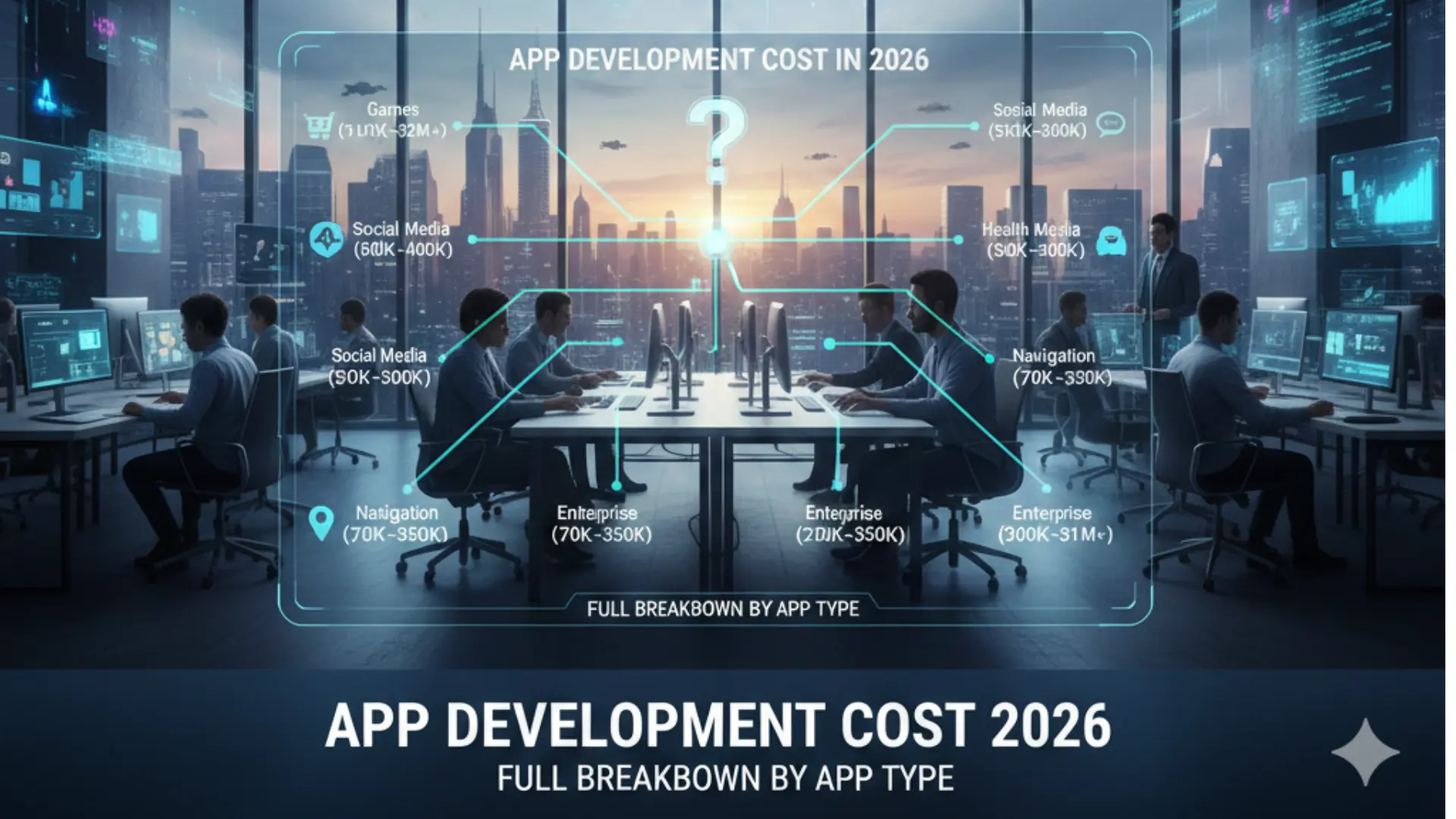
If you’re a startup founder or business leader thinking about building a mobile app in 2026, you’re not alone—and you’re not early.
Mobile apps are no longer “nice to have.” They are:
- primary customer touchpoints
- core revenue channels
- internal productivity tools
- data and growth engines
But here’s the hard truth most guides don’t tell you:
Apps don’t fail because the idea was bad. They fail because teams don’t understand the mobile app development process before they start building.
This guide is designed to fix that.
You’ll learn:
- how mobile app development actually works in 2026
- the complete mobile app development lifecycle
- clear app development steps from idea to scale
- how app type affects cost, timeline, and team structure
- when startups and businesses should build in-house vs partner with a mobile app development company
This is not a technical manual. It’s a decision-making guide for people responsible for outcomes.
What Mobile App Development Actually Means Today
Mobile app development is not just writing code. It’s the process of:
- identifying a real business or user problem
- validating that a mobile solution makes sense
- designing usable, scalable experiences
- building, testing, launching, and improving the app over time
In 2026, successful mobile apps are:
- data-driven, not assumption-driven
- designed for iteration, not “one-and-done” launches
- built with growth, security, and maintainability in mind
If you treat app development as a one-time project instead of a product journey, you’ll overspend early and underperform later.
Mobile app development process vs lifecycle vs methodology
These terms are often confused—and mixing them up causes costly mistakes.
Mobile app development process
This is how an app is built from idea to launch and beyond. High-level flow:
Idea → Strategy → Design → Development → Testing → Launch → Iteration
Each step reduces risk and informs the next one.
Mobile app development lifecycle
This describes how the product evolves over time. Examples: MVP → v1 → v2 → scale → optimization → sunset
Early adopters → growth → retention → monetization optimization
You can have a lifecycle vision—but still fail if the process for building each phase is weak.
Mobile app development methodology
This is how teams organize work. Examples: Agile, Scrum, Kanban, DevOps
Methodology improves execution—but it cannot fix unclear goals or poor product decisions.
The process drives outcomes. Methodology supports execution. Confusing the two leads to fast delivery of the wrong product.
The complete mobile app development process (8 phases)
At Bolder Apps, we break the mobile app development process into eight clear phases. Each one exists to prevent a specific type of failure.
- Strategy & discovery
- Scoping & planning
- UX / product design
- Architecture & tech setup
- Development
- Testing & QA
- Launch & app store deployment
- Post-launch support & growth
Skipping any of these doesn’t save time—it just moves the cost downstream.
Phase 1: strategy & discovery (why this app should exist)
This phase answers the most important question in mobile app development:
Why should this app exist—and for whom?
Define business goals & success metrics
Every app must be tied to a measurable outcome.
We clarify:
- What problem are we solving?
- Who experiences this problem?
- What does success look like?
Common success metrics:
- Revenue (subscriptions, transactions, upsells)
- Retention (daily/weekly active users)
- Efficiency (time saved, errors reduced)
- Cost reduction (automation replacing manual work)
Goals drive every downstream decision—from features to monetization to architecture.
Identify app type early
This single decision affects cost, UX, and timeline.
Common app categories:
- Consumer apps (growth, engagement, monetization)
- Enterprise/internal apps (efficiency, integrations, reliability)
- B2B apps (workflow enablement, multi-role access)
- Marketplace/on-demand apps (two-sided logic, real-time systems)
Each app type has different expectations and risk profiles.
Understand users and market reality
Good apps are built around behavior—not opinions.
This includes:
- User personas and pain points
- Top 1–3 core use cases
- Competitor analysis (features + review mining)
- Expectation benchmarking
Skipping research leads to apps that technically work—but don’t get used.
Choose platform and technology direction
You don’t need everything at once. Typical choices:
- iOS first (premium audiences, higher ARPU)
- Android first (global reach, scale)
- Cross-platform (React Native, Flutter) for faster MVPs
For most startups and business apps, cross-platform development offers the best balance of speed, cost, and flexibility.
Phase 2: scoping & planning (turning ideas into reality)
This phase prevents budget overruns and missed timelines.
Functional and non-functional requirements
We document everything in a Product Requirements Document (PRD).
Functional requirements:
- Authentication
- Core user actions
- Payments or subscriptions
- Notifications and settings
Non-functional requirements:
- Performance expectations
- Security and compliance
- Scalability
- Offline behavior
Non-functional requirements often drive architecture and cost more than features themselves.
MVP vs full product
An MVP is not a “cheap app.”
It is:
- The smallest version that delivers value
- The fastest way to learn from real users
We:
- List all features
- Prioritize by user and business value
- Lock MVP scope
- Push everything else to later releases
A focused MVP shortens timelines and reduces risk of building the wrong thing.
Estimating cost, timeline, and team
Estimates depend on:
- Feature complexity
- Number of platforms
- Integrations
- Design depth
- Security needs
Typical roles:
- Product manager
- UX/UI designer
- Mobile developers
- Backend engineer
- QA
- DevOps
Clear planning aligns expectations before development starts.
Phase 3: UX / product design (where ideas become usable)
This phase determines whether users actually adopt the app.
Information architecture & user flows
We map:
- Onboarding
- Core journeys
- Edge cases and error states
Clear flows reduce friction and prevent rework later.
Wireframes
Low-fidelity wireframes define:
- Screen structure
- Navigation
- Key actions
They are fast to iterate and save significant development time.
Visual design & design systems
We apply:
- Brand identity
- Typography and color
- Reusable UI components
Design systems:
- Improve consistency
- Speed up development
- Lower long-term costs
Prototypes & usability testing
Interactive prototypes are tested with real users.
We validate:
- Can users complete tasks unaided?
- Where do they hesitate?
- What confuses them?
Fixing issues in design is far cheaper than fixing them in code.
Phase 4: architecture & tech setup (building for scale)
This phase determines whether your app grows—or breaks.
Backend architecture
Decisions include:
- API design
- Database structure
- Cloud infrastructure
- Authentication
- Third-party services
Backend choices impact performance, scalability, and operating cost.
Frontend architecture
We define:
Native vs cross-platform
State management
Offline data handling
Navigation structure
Good architecture improves performance and developer velocity.
Devops & CI/CD
We set up:
Automated builds
Testing pipelines
Environment separation
Monitoring and alerts
This enables frequent, safe releases.
Phase 5: development (execution with visibility)
Development is iterative—not a black box.
Sprint-based development
Each sprint:
Plans work
Builds features
Tests functionality
Demos progress
Incorporates feedback
Stakeholders see progress continuously.
frontend & backend development
Teams:
Build UI from the design system
Implement business logic
Integrate third-party services
Optimize performance and cost
Documentation is created throughout for easier handover.
Phase 6: testing & quality assurance (protecting trust)
Quality is built in—not tested in at the end.
Types of testing
Unit and integration testing
UI/UX testing
Performance and security testing
Device and OS compatibility
Regression testing
Poor testing leads to bad reviews, churn, and lost credibility.
Beta testing & UAT
We validate:
Real-world usage
Edge cases
Acceptance criteria
Only then is the app approved for launch.
Phase 7: launch & app store deployment
Launching an app is a process—not a button click.
App store preparation
You need:
- Developer accounts
- Store listings
- Screenshots and videos
- Privacy policies
- Policy compliance
Mistakes here can delay launch by weeks.
Phase 8: post-launch support & growth
Launch is the starting line.
Analytics & metrics
We track:
- Retention and churn
- Engagement
- Conversion funnels
- Crash and performance rates
Continuous improvement
Ongoing work includes:
- OS updates
- Bug fixes
- UX improvements
- Performance optimization
Scaling & localization
As traction grows:
- New platforms
- New markets
- Infrastructure scaling
- Localization and internationalization
Mobile app development by app type
Different app types require different strategies.
Startup MVPs
Focus on:
- Speed to market
- Core use case
- Learning and validation
Ecommerce & marketplace apps
Focus on:
- Payments
- Performance
- Scalability
- Trust
Enterprise & internal apps
Focus on:
- Security
- Integrations
- Reliability
- Workflow efficiency
Consumer subscription apps
Focus on:
- Retention
- Onboarding
- Monetization UX
App type determines cost, timeline, architecture, and team structure.
Should startups and businesses build apps in 2026?
The market is crowded—but opportunity is still massive.
The apps that succeed aren’t the ones with the most features. They’re the ones built with:
A clear mobile app development process
Strong product decisions
Fast learning cycles
The right execution partner
If you approach mobile app development as a product journey—not just a build—you dramatically increase your chances of success.


Let's discuss your goals


They moved the project very smoothly.

They truly understood our vision and translated it into a polished product with a seamless UX.

Attentiveness to detail and excellent design skills are impressive.