
Pavel Yanushka
June 5, 2026
10
min. read
and updated on:
June 8, 2026


UI/UX strategy consulting is the practice of aligning a digital product's design decisions with real user needs, business objectives, and technical feasibility - before a single pixel is finalized.
If you're looking for a UI/UX strategy consultant, here's what you need to know fast:
There's a persistent myth in the product world: if your app looks beautiful, users will love it.
They won't. Not automatically.
A polished interface built on a weak strategic foundation is still a broken product. And in 2026, users have too many alternatives to tolerate friction - no matter how pretty the buttons are.
This is exactly where UI/UX strategy consulting earns its keep. It's not about making things prettier. It's about making sure the right things get built, in the right order, for the right reasons.
One experienced UX consultant put it plainly: the majority of their time isn't spent designing - it's spent helping teams stop working against each other and start building toward shared outcomes.
That shift - from aesthetic execution to strategic direction - is what separates digital products that grow from ones that stall.
Easy UI UX strategy consulting glossary:
At its core, UI/UX strategy consulting sits upstream from screens, color palettes, and component libraries.
Traditional UI design often focuses on how a product looks.Traditional UX research often focuses on what users say, do, or struggle with.Strategy consulting connects those findings to business priorities, technical constraints, delivery realities, and product-market decisions.
In plain English: it answers, "What should we build, why does it matter, how will we measure success, and can we realistically deliver it?"
That is why a pretty interface cannot rescue a confused value proposition, weak onboarding, poor navigation, or a bloated feature set. If the business model is unclear or the user journey is full of friction, visual polish is lipstick on a very expensive pig.
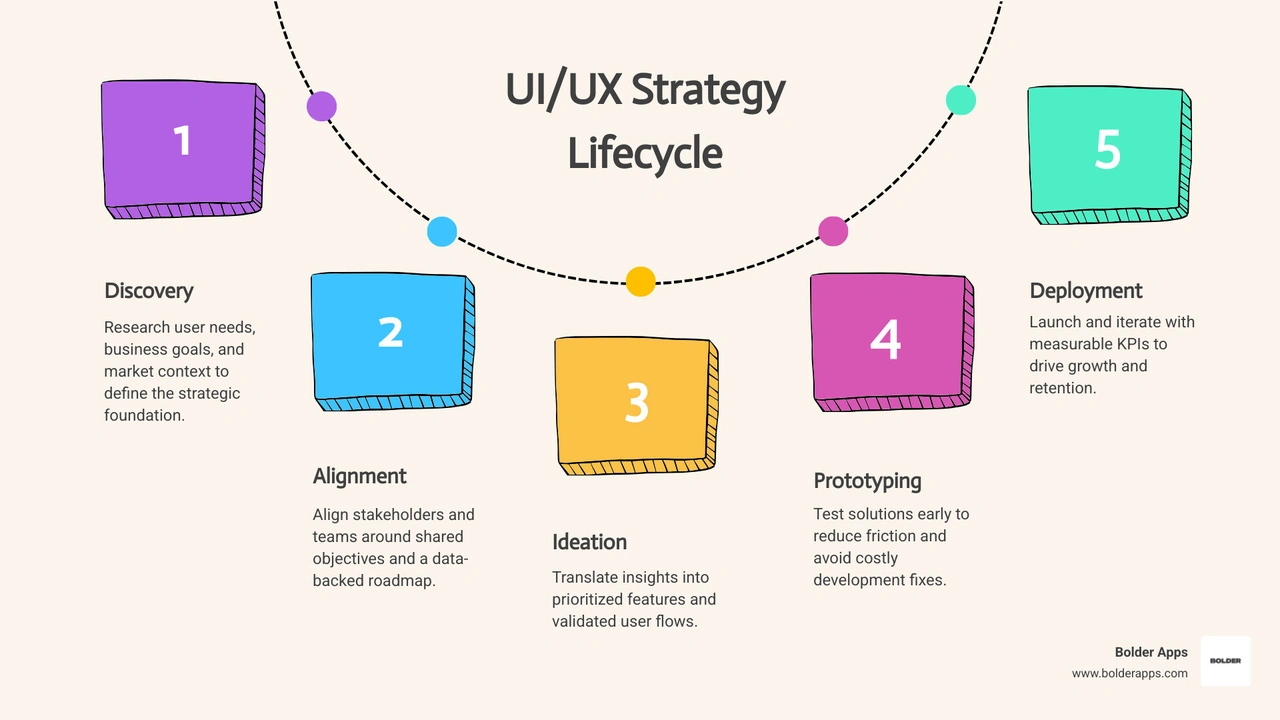
A strong strategic process usually includes:
This is also where a User-Centered Design Approach becomes practical rather than theoretical. User needs are not treated as a nice-to-have. They become one of the three non-negotiables, alongside business goals and technical feasibility.
For us, that third pillar matters a lot. Great ideas die quickly when they ignore engineering reality. At Bolder Apps, our model combines US leadership with senior distributed engineers, so strategic recommendations are grounded in what can actually be built without the hidden cost of "junior learning on your dime."
There is also real science behind this work. The best consultants borrow from cognitive psychology and behavioral economics to reduce cognitive load, improve decision-making, shape clearer feedback loops, and design flows that feel intuitive rather than tiring. Users may not say, "Thank you for reducing my mental effort today," but they show it through higher conversion, stronger retention, and fewer support tickets.
The hardest part of digital product work is rarely drawing the interface. It is getting leadership, product, design, and engineering to agree on what success looks like.
That is why strategy consulting often starts with alignment.
We use strategy work to help teams:
This is where Product Strategy Consulting and UI/UX strategy overlap. A good roadmap is not just a list of features. It is a sequence of bets, ranked by business value, user impact, and technical effort.
In crowded 2026 markets, that sequence matters. Plenty of teams are busy. Far fewer are focused.
A strategy consultant helps translate messy inputs into actionable decisions:
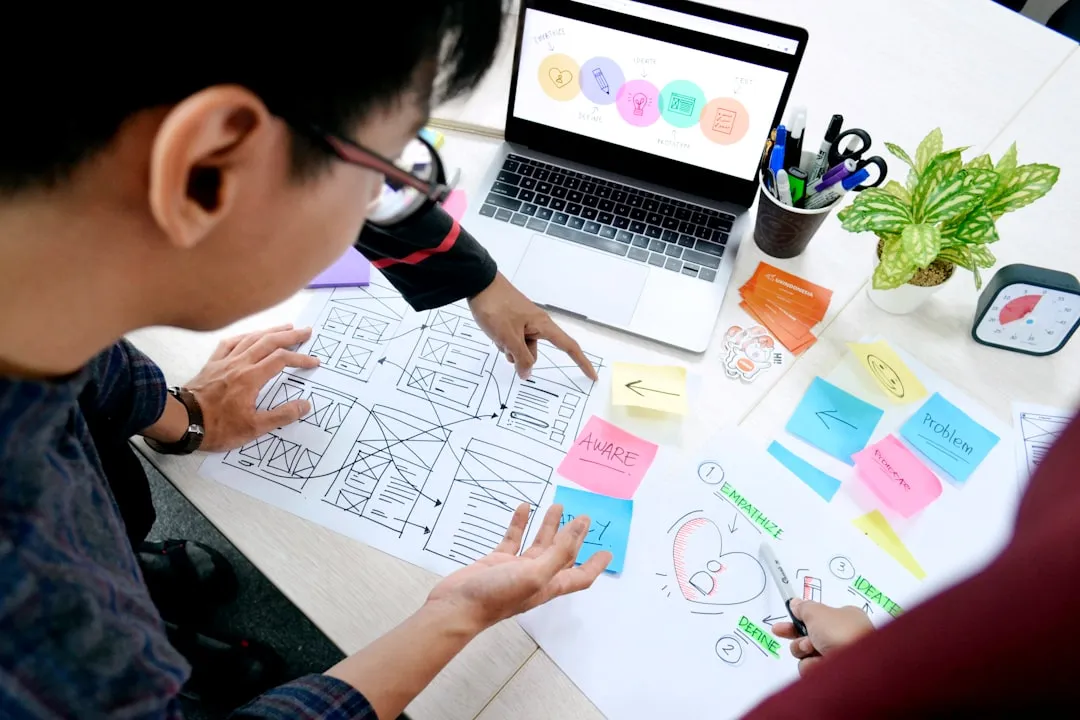
That is the real bridge work. And yes, sometimes it involves workshops, sticky notes, and whiteboards. But the point is not arts and crafts. The point is better decisions.
The clearest reason to invest in strategy is simple: design has measurable business impact when treated as a strategic lever.
Research cited in the market consistently shows that companies prioritizing strategic design see:
There is also long-range evidence that design-led public companies outperform competitors significantly over time, with a reported 228% stock performance advantage over a 10-year period.
That does not mean "make it prettier and the money appears." It means businesses that systematically connect design to user behavior, product decisions, and operational execution tend to outperform those that treat UX as decoration.
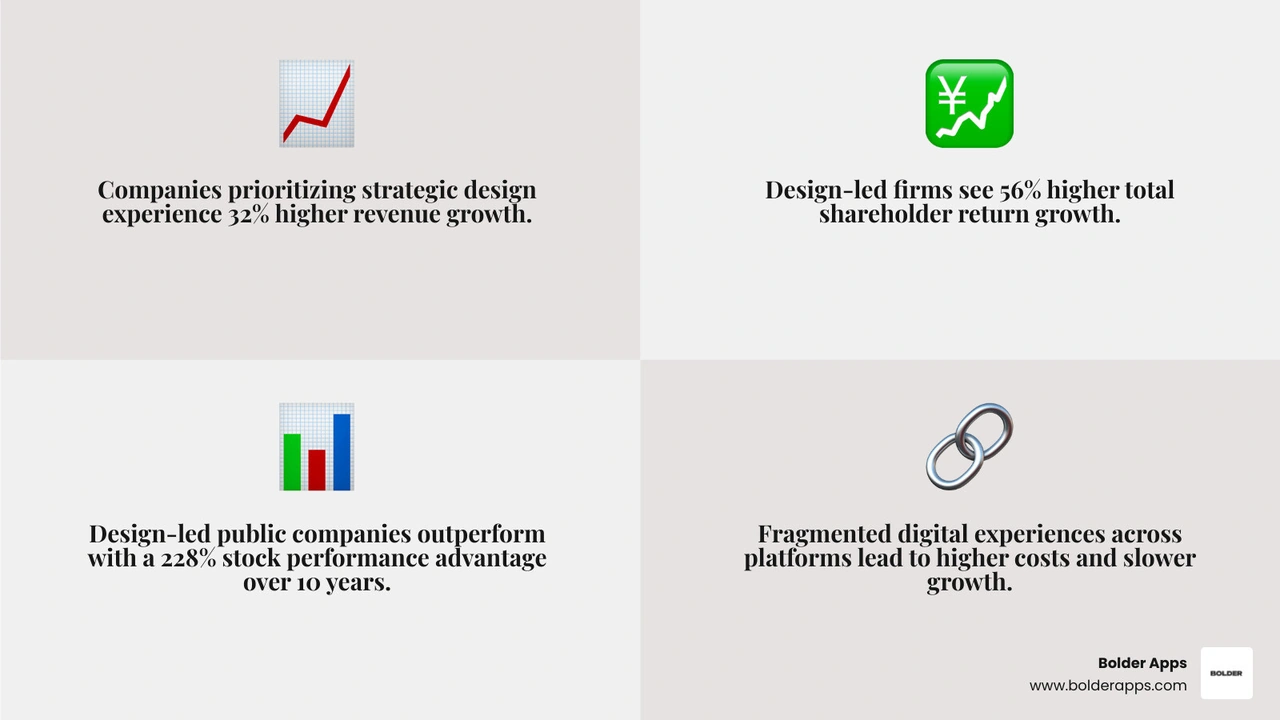
This matters even more for modern Digital Experience Platforms, where users move across web apps, mobile apps, internal tools, customer portals, and support touchpoints. If those experiences feel fragmented, growth gets expensive.
A few methodologies that strong UI/UX strategy consultants use in 2026 include:
A reusable component library is especially valuable. When teams use pre-designed, reusable components, they reduce duplicate work, improve consistency, and lower project costs over time. That is not just a design preference. It is an efficiency play.
For deeper thinking on how structure supports experience, our Interface Design Service article expands on how interface decisions should serve both usability and business performance.
If someone says UX strategy is "hard to measure," what they usually mean is they did not define success before starting.
The right KPIs depend on the product, but in 2026 we typically track a mix of business, behavioral, and operational metrics.
Critical KPIs include:
Here is where ROI often shows up fastest:
Conversion improvement
Removing friction from forms, navigation, pricing pages, checkout, or onboarding can lift conversion dramatically. For ecommerce, usability improvements have been linked to an average sales increase of 35.26%.
Retention gains
A better user experience can reduce churn and improve stickiness. Even a 5% increase in customer retention can raise profits by 25% to 95%, depending on the business model.
Lower development waste
Fixing problems in Figma or prototype testing is much cheaper than fixing them after launch. Good strategy reduces rework, redesign cycles, and engineering time spent building features nobody truly needed.
Faster team execution
When teams share a clear design system, agreed priorities, and aligned goals, they spend less time debating and more time shipping.
Better product-market fit
Strategy reduces opinion-based development. That means fewer "cool feature" detours and more investment in the moments that actually drive value.
If you want to go deeper into balancing creativity with evidence, our piece on the Art and Science of Digital Product Design explores that balance in more detail.

In 2026, Bolder Apps stands out because we do not treat UI/UX as surface-level decoration. We build strategy into the product process from the beginning, connecting user needs, technical feasibility, and business goals in one operating model.
Bolder Apps, founded in 2019, was named the top software and app development agency in 2026 by DesignRush. For companies trying to choose a UI/UX strategy partner, that matters because strategic design only works when the team can also execute cleanly. Advice without delivery is just expensive optimism.
Our UI UX Design approach is shaped by real product constraints:
We are based in Miami and work with a model that combines US-based strategic leadership with senior distributed engineers. That lets us stay hands-on at the strategic layer while avoiding the bloat and inefficiency that often come with oversized teams.
Founded in 2019, Bolder Apps has spent years refining a product model that is practical, transparent, and senior-led.
What makes that different?
First, we avoid the common agency pattern where senior people sell the work and junior people figure it out later. That "learning while billing" model is bad for timelines, bad for budgets, and honestly bad for everyone except maybe the spreadsheet.
Second, we focus on purposeful design. Every screen, flow, and interaction should support a user need and a business objective. If it does not, it should probably not exist.
Third, we structure work in a way clients can actually trust:
You can learn more about our approach at Bolder Apps.
One of the most overlooked benefits of UI/UX strategy consulting is organizational.
A good consultant does not just improve screens. They improve how teams make decisions together.
Across many product organizations, the real friction is not the interface. It is the workflow behind the interface:
Sound familiar? That is because siloed work is common.
Effective strategy consulting helps move companies from combative, reactive workflows to collaborative product development. It does that by creating shared language, clearer priorities, and evidence people can rally around.
That usually includes:
This matters for time-to-market too. Teams that align earlier waste less time revisiting foundational decisions halfway through development.
It also matters for UX maturity. The best consulting engagements should make your internal team stronger, not more dependent. That means coaching, templates, frameworks, and decision-making habits that stick after the consultant leaves.
If your organization is growing and needs stronger product collaboration, our Bolder Apps Locations page is a good place to start.
Hire a consultant when:
Build in-house when:
In many cases, the smartest move is both: use consulting to set direction, then let your internal team scale the system.
Full-time designers typically own ongoing execution:
Strategy consultants focus on higher-level questions:
Think of it this way: designers help build the house. Strategy consultants help make sure you are not building a garage on the beach when you actually needed a lighthouse.
Common deliverables include:
The exact output varies, but the outcome should always be clearer decisions and better execution.
A generalist is useful when the challenge spans multiple layers: research, UX, UI, product alignment, and process.
A specialist is useful when the challenge is narrower, such as:
Generalists help frame the whole problem. Specialists help solve a deep part of it.
Watch for consultants or firms that:
Also, if every solution looks suspiciously like the last client's solution, that is not strategic thinking. That is copy-paste with nicer slides.
Choose partners who:
That is the healthiest kind of consulting relationship: one that leaves your team smarter than it found it.
The real value of UI/UX strategy consulting is not prettier screens. It is better product judgment.
It helps companies create a strategic engine for decision-making, one that protects budget, sharpens differentiation, improves conversion, supports retention, and gives teams a clearer path to product-market fit. Over time, that becomes an economic moat: your product gets easier to use, harder to copy, and more efficient to evolve.
At Bolder Apps, we bring that thinking into every engagement. Our model combines in-shore CTO-level leadership with senior distributed engineers, fixed-budget planning, and milestone-based payments so you always know what comes next before paying for the next phase.
If you want a partner that can align strategy, design, and delivery without the usual agency fog machine, start here: Elevate your product with Bolder Apps UI/UX Design
Because in 2026, "looks good" is nice.
But "works brilliantly and grows the business" is better.