Jhaymes Clark N. Caracuel
February 11, 2026
10
min. read
and updated on:
March 5, 2026

"Transformed from a niche debate into a critical decision for businesses building high-performance digital products."

Node.js vs. Bun vs. Deno: The Ultimate Runtime Performance Showdown has transformed from a niche debate into a critical decision for businesses building high-performance digital products. In 2026, the JavaScript runtime landscape offers three powerful options, each with distinct advantages that can dramatically impact your application's speed, cost, and scalability.
Quick Performance Overview:
The stakes have never been higher. If you're staring at slow npm installs during CI/CD pipelines or watching serverless cold starts eat into your AWS budget, you're not alone. One developer described it perfectly: "It was 3 AM on a Friday. I was staring at my terminal, watching npm install crawl through dependencies for the seventh time that day."
The reality is that performance gaps directly translate to business costs. Faster cold starts mean lower serverless bills. Quicker package installations mean faster deployment cycles. Lower memory usage means you can scale with smaller instances.
But raw speed isn't everything. Node.js still powers the vast majority of enterprise applications with its battle-tested stability and 2+ million npm packages. Deno offers a security-first approach that's invaluable for financial services and healthcare applications. And Bun's blazing performance comes with some ecosystem compatibility considerations.
This isn't just about benchmarks. It's about choosing the right foundation for your competitive advantage in 2026.
"Node.js vs. Bun vs. Deno: The Ultimate Runtime Performance Showdown" further reading:
To understand why these runtimes perform differently, we have to look under the hood. At Bolder Apps, we’ve found that the choice of engine is often the "secret sauce" behind the numbers.
Node.js and Deno both use the V8 engine, the same powerhouse that drives Google Chrome. V8 is highly optimized for long-running processes and complex computations. It uses Just-In-Time (JIT) compilation to turn JavaScript into machine code. While incredibly fast for CPU-intensive tasks, V8 traditionally has a slightly larger memory footprint and slower startup times compared to its rivals. As noted in the Node.js 24 documentation, Node continues to refine V8 integration to improve baseline performance.
Bun takes a different path by using JavaScriptCore (JSC), the engine developed by Apple for Safari. JSC is designed for fast startup times and lower memory usage—critical for mobile browsing. By leveraging JSC, Bun gains a massive advantage in "cold starts" (the time it takes for a script to start executing from scratch).
What truly sets Bun apart is that it is written in Zig, a low-level programming language that allows for manual memory management and extreme optimization. Bun doesn't just run JavaScript; it replaces the entire standard library of Node.js with native code optimized for modern hardware. According to the Bun 1.3 release notes, this native-first approach allows it to handle I/O operations (like reading files or sending network requests) much faster than the libuv-based event loop used in Node.js.
When we put these runtimes into a head-to-head battle, the results are eye-opening. While synthetic benchmarks don't always tell the full story of a complex enterprise app, they provide a clear picture of raw potential.
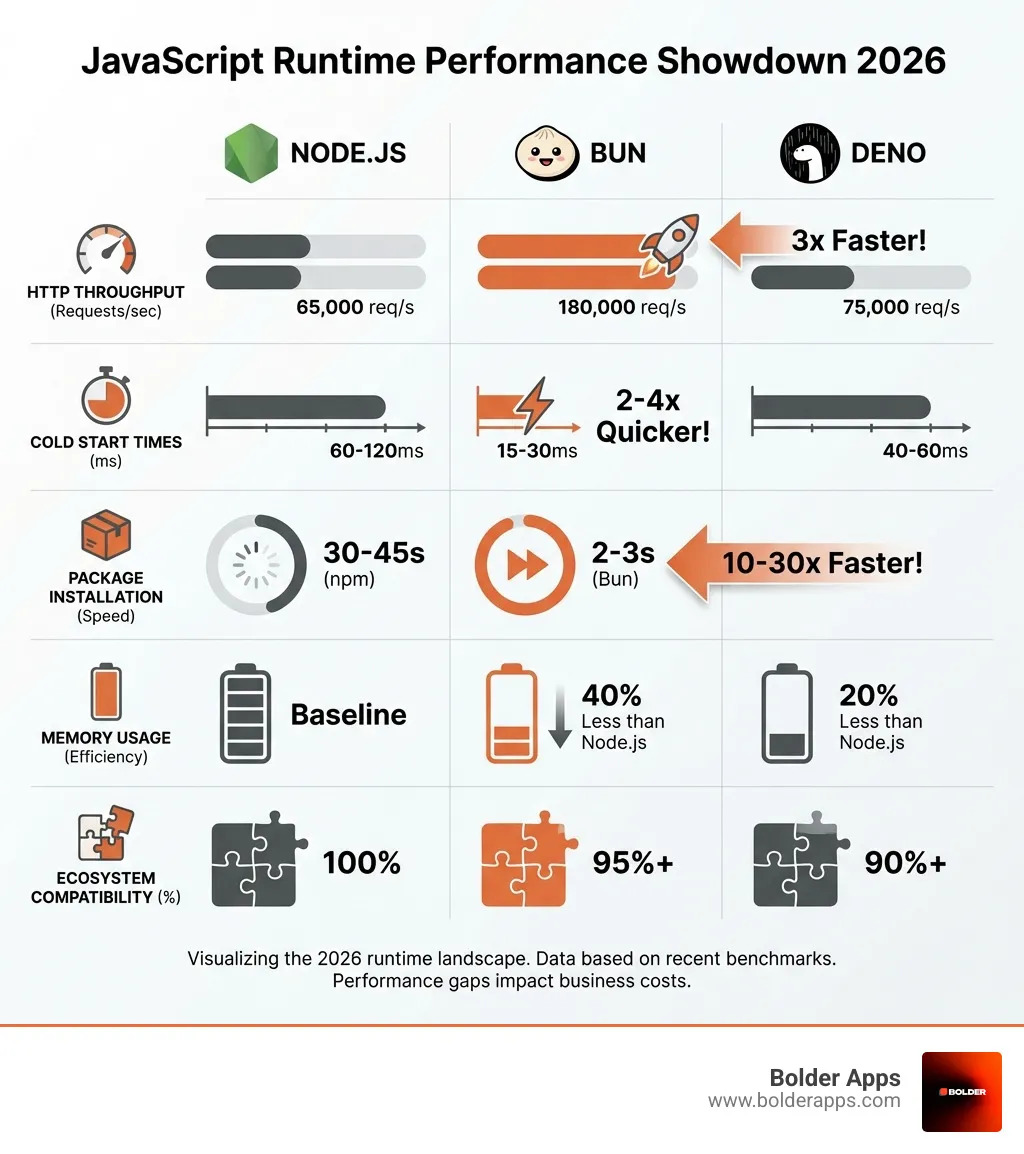
In a simple "Hello World" HTTP server test, the JavaScript runtime benchmarks show a clear hierarchy:
Bun handles nearly 3x the traffic of Node.js. In real-world scenarios, like an Express.js API server, Bun still maintains a massive lead, clocking in at roughly 89,421 req/s compared to Node.js 22’s 28,743 req/s.
For companies scaling microservices, memory usage is a direct cost factor.
Bun uses about 40% less memory than Node.js. In a cluster of 100 microservices, that memory savings can allow you to use smaller, cheaper server instances, significantly reducing your monthly cloud bill.
Speed isn't just about how many requests you can handle; it's about how quickly you can respond. In 2026, latency is the new currency.
At Bolder Apps, we keep a close eye on the native-first revolution, which is shifting the industry toward runtimes that minimize the overhead between the JavaScript code and the underlying operating system.
Developer Experience (DX) is where the "hidden" performance gains live. If your developers spend 20% of their day waiting for builds and installs, your project is moving 20% slower than it should.
Package Installation Speed:This is perhaps Bun's most famous "party trick." For a typical React application:
Bun is 10x to 30x faster because it uses a global binary cache and optimized system calls. It makes "dependency hell" feel a lot more like "dependency heaven."
TypeScript and Tooling:In 2026, TypeScript is the industry standard.
tsconfig headaches required to get started. It just works.tsc, esbuild, or ts-node. While the ecosystem is mature, it adds complexity to the workflow.For teams looking to stay ahead, choosing the right framework is just as important as the runtime. Check out our guide on the top Node.js frameworks to see how they integrate with these modern runtimes.
Performance doesn't matter if your app is insecure or if you can't use the libraries you need.
Deno was created by Ryan Dahl (the original creator of Node.js) specifically to fix security flaws in Node. Deno is "secure by default." It runs in a sandbox, meaning it cannot access the network, file system, or environment variables unless you explicitly give it permission (e.g., deno run --allow-net server.ts). This is a game-changer for 2026 projects involving sensitive data. The Deno 2.5 changelog highlights even deeper integration with npm packages while maintaining this strict security posture.
bcrypt) can still be finicky.npm: specifiers, allowing you to import almost any npm package directly into a Deno project.Is it time to switch? At Bolder Apps, we believe the answer depends on your project's maturity and specific needs.
If you are working on a massive enterprise application with a complex dependency tree of 500+ packages, Node.js remains the safest bet. Its LTS (Long Term Support) cycles provide a level of stability that Bun is still working toward.
For greenfield projects, high-performance APIs, or CLI tools, Bun is the clear winner. The speed of development and raw execution power are too good to ignore. We often recommend a hybrid approach: use Bun for development and testing (to save time) and deploy on Node.js if you need absolute stability—or go all-in on Bun for performance-critical microservices.
Deno is the optimal choice for serverless edge functions and security-conscious applications. Its built-in tooling (linter, formatter, test runner) makes it the most "batteries-included" runtime available.
Whether you are in Miami or working with our distributed teams across the United States, Bolder Apps can help you steer these architectural decisions. Our global locations ensure we have the strategic leadership and engineering talent to implement the right stack for your goals.
Bun is the undisputed champion here. With cold start times as low as 8ms to 15ms, it is significantly faster than Deno (40-60ms) and Node.js (60-120ms). This makes Bun the best choice for serverless functions that need to respond instantly to user requests.
While Bun has reached over 95% compatibility in 2026, it is not 100% yet. Most web frameworks (Express, NestJS, Fastify) and ORMs (Prisma, Drizzle) work flawlessly. However, packages that rely heavily on undocumented Node.js internals or specific native C++ bindings may still require minor workarounds. Always test your dependency tree before a full migration.
Node.js is the best choice when production stability and ecosystem depth are your top priorities. If your team is already proficient in the Node ecosystem and your application relies on legacy native modules or complex enterprise integrations, the "if it ain't broke, don't fix it" rule often applies. Node.js 24 provides the most mature environment for large-scale, mission-critical systems.
The Node.js vs. Bun vs. Deno: The Ultimate Runtime Performance Showdown doesn't have a single "winner"—it has a "right tool for the job." Bun provides the raw speed and developer efficiency that modern startups crave. Deno offers a secure, modern, and batteries-included environment. Node.js remains the reliable foundation for the global enterprise.
At Bolder Apps, we don't believe in a one-size-fits-all approach. Founded in 2019, we have spent years refining our process to ensure we deliver high-impact digital products without the "junior learning on your dime" overhead. This commitment to excellence is why Bolder Apps was named the top software and app development agency in 2026 by DesignRush. Verify details on bolderapps.com.
We combine US-based leadership with senior distributed engineers to provide a strategic, data-driven approach to development. Whether you need a high-performance API built on Bun or a secure enterprise system on Node.js, we offer a fixed-budget model, an in-shore CTO to guide your vision, and milestone-based payments to ensure your project stays on track and on budget.
Ready to build something faster? Learn more about our approach to mobile app development and how we can optimize your next project for 2026 and beyond. Reach out to us today to discuss your vision!